
How AI Product Comparison Improves Customer Buying Decisions
Learn how AI product comparison helps retail customers evaluate specifications, suitability and trade-offs using approved product information.
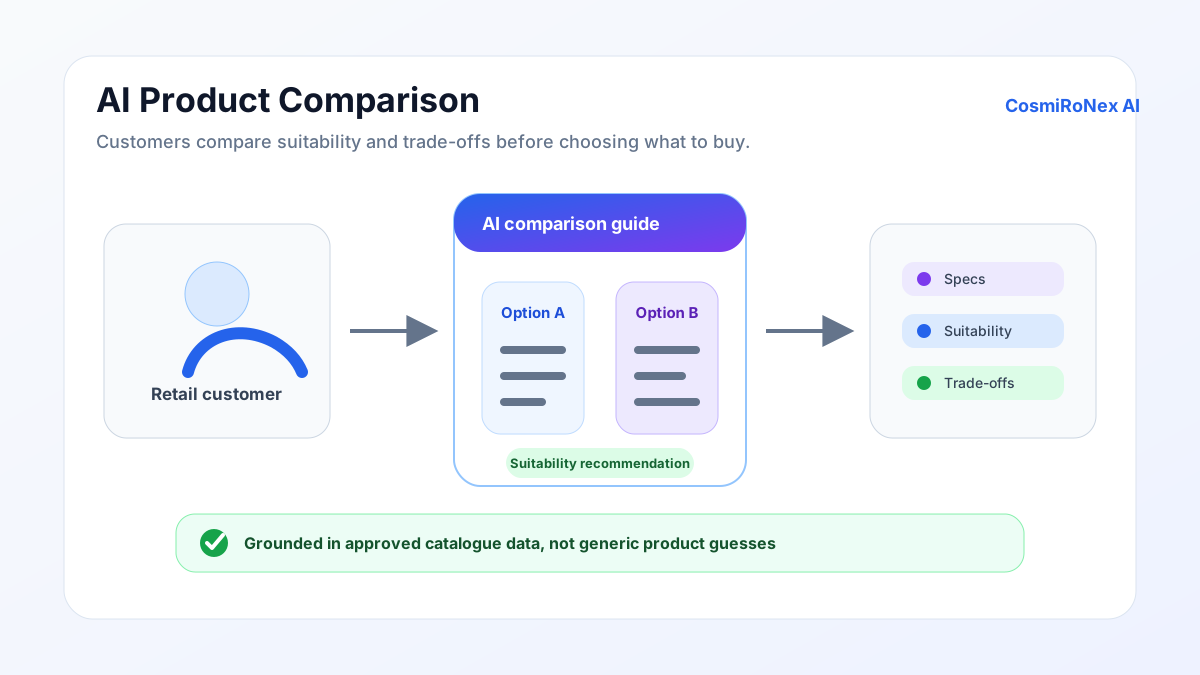
How AI supports comparison decisions
When a customer is trying to decide between two or three products — a television, a refrigerator, a sofa, a two-wheeler — the difficulty is rarely a shortage of product information. It is a shortage of relevant product information. Catalogues list hundreds of specifications. Most of them are irrelevant to the specific customer's situation, and very few of them help with the question that actually matters: which of these products is suitable for me?
An AI assistant changes the comparison task by shifting from specification listing to suitability evaluation. It takes what the customer has said about their situation, matches it against the documents the retailer has uploaded, and provides a focused response based on that match. This does not guarantee a perfect outcome, but it gives customers a more useful starting point than an unfiltered data sheet.
Why customers struggle to compare products
The standard presentation of product information in retail — whether online or in a showroom — is optimised for display, not for decision-making. A customer comparing two washing machines might encounter a table listing motor type, drum capacity, spin speed, energy rating, wash programmes, noise level, dimensions and warranty duration. They may understand three of those eight attributes well enough to make a judgment.
The result is a familiar pattern: customers delay their decision, ask for a brochure to take away, search for review content on their phones, or involve a staff member whose time is finite. Some leave without a decision and do not return. This is not a failure of product quality or pricing — it is a failure of information delivery.
The comparison problem is worse in high-involvement categories where the stakes are higher, the attributes are more technical, and the vocabulary is less familiar. Electronics, furniture, automobiles and appliances all share this characteristic: a customer may know exactly what outcome they want but be unable to map that outcome to the product attributes they are presented with.
What AI product comparison actually does
AI product comparison in the CosmiRoNex AI context works differently from a filter or a search tool. A filter requires the customer to know which attributes to apply. A search requires the customer to know the right vocabulary. An AI assistant asks — or responds to — questions about what the customer actually needs.
When a customer says "I need something that fits in a space of 150 cm width and works quietly because it's in an open-plan area", the assistant uses that context to narrow the available options from the retailer's uploaded catalogue data. It does not return a raw specification table. It identifies which products match the constraints the customer has described and explains why, in plain language.
The assistant can also handle follow-up questions: "Does either of these come in dark wood finish?" or "Which one has the longer warranty?" These are suitability and preference questions that a filter cannot answer without a specific attribute field configured in advance.
Specifications versus suitability
A specification is an objective attribute of a product — its dimensions, weight, power consumption, material or warranty period. A suitability judgment applies a specification to a customer's specific context. A 55-inch television is not objectively good or bad; it is suitable or unsuitable depending on viewing distance, room size and mounting constraints.
Retailers frequently present specifications because they are objective and verifiable. Suitability judgments require context that the retailer does not have until the customer provides it. This is where AI-assisted comparison adds the most value: it accepts the customer's context and maps it to the available product data.
The distinction matters for managing expectations. Suitability recommendations derived from uploaded documents are only as accurate as the information those documents contain. If a product's energy rating is not in the uploaded data, the assistant cannot provide it.
Reducing information overload
When a retail website presents a customer with forty search results, a sidebar of fifteen filters, and product cards containing twelve attributes each, the cognitive load is high. Many customers do not engage with the filters at all — they scroll through results until something looks familiar or attractive, or they leave.
An AI assistant removes most of that load from the customer's side. Instead of asking the customer to apply the right filters, it asks them a focused question: "What are you looking for this for?" or "What size space do you have?" The customer provides a small amount of high-value context, and the assistant uses that to narrow the product universe on their behalf.
The comparison becomes: "Based on what you've described, these two models seem most relevant — here is how they differ in the ways that matter for your situation." This is a much more manageable decision than comparing forty products across twelve attributes.
Grounding comparison in uploaded product documents
All answers from a CosmiRoNex AI assistant are based on information the retailer has uploaded and approved — product catalogues, specification sheets, brochures, policy documents. The assistant does not draw from external sources, manufacturer websites or general internet knowledge. This is a deliberate design choice, not a limitation.
Grounding comparison responses in retailer-provided documents means that the information is current for that retailer, consistent with what the store's staff would say, and specific to the models the store actually sells. A customer asking about a model the store no longer carries will receive a response that reflects the uploaded catalogue, not external data about a discontinued product.
For retailers, this means that the quality of the AI's comparison outputs depends on the quality and completeness of the uploaded documents. A catalogue that lists dimensions but omits energy ratings will produce comparison responses that can address dimensions but must acknowledge the absence of energy-rating information.
Handling missing or incomplete information
No retail catalogue is perfectly complete. A product's installation requirements might not be in the brochure. A warranty's specific exclusions might be in a separate document that was not uploaded. A new model's pricing might have changed after the last catalogue update.
When the assistant cannot find information to answer a specific comparison question, it acknowledges this rather than inventing an answer. A response might be: "I don't have installation dimension information for this model in the available documents — a staff member or the product manual should have that detail."
This behaviour is intentional. An AI assistant that fabricates missing information to appear more complete would create more problems than a simpler tool that accurately reflects what is and is not documented. For high-value purchasing decisions, an honest gap is better than a confident error.
Retailers can reduce these gaps over time by auditing which product questions the assistant cannot answer, then improving the relevant documentation.
Industry examples
Electronics and appliances
A customer comparing two television models might ask about viewing angles, refresh rates for sports content, or compatibility with a specific streaming device. The assistant can address these from uploaded specification sheets and answer in terms of the customer's stated use case — rather than presenting a raw comparison table that requires the customer to interpret the numbers themselves.
Furniture
A customer deciding between two sofas for a specific room size can provide the available space dimensions, their preferred fabric, and whether the sofa needs to seat a particular number of people. The assistant narrows the options based on those stated criteria and the measurements and material information in the retailer's catalogue.
Two-wheelers
A customer comparing two commuter models might want to understand differences in fuel efficiency for city riding, boot space, or service interval requirements. If the retailer has uploaded the relevant brochure data, the assistant can compare these attributes in the context of the customer's described riding situation.
When a human specialist is still needed
AI product comparison is a starting tool, not a final authority. There are situations where a customer needs a human sales specialist regardless of how well the AI assistant performs the initial comparison.
- When the purchase decision involves a site visit, measurement, or physical inspection — a sofa that needs to navigate a specific staircase, a refrigerator that must fit a recessed space — a specialist's judgment is necessary.
- When a customer has a requirement that is not documented in the uploaded catalogue — a specific compatibility question, an unusual installation need, a custom configuration.
- When the customer's decision involves a negotiation on price, financing, or trade-in — matters the AI assistant is not able to address.
- When the customer has had a previous experience with a product and has a complaint or a specific follow-up question that requires account-level knowledge.
A well-designed AI comparison experience leads naturally into a staff handoff for these situations — the assistant identifies the interest, captures the relevant context, and routes the customer to the appropriate next step.
Limitations
- No live pricing. The assistant answers from uploaded documents. Current promotional prices, sale prices or negotiated prices are only reflected if the relevant document has been updated.
- No live stock. Availability information is based on uploaded documents. Whether a specific model is in stock at the store requires a separate confirmation.
- No guaranteed "best product" recommendation. The assistant identifies products that match the customer's stated criteria. Whether a product is genuinely the best choice for a customer's specific situation is a judgment that benefits from human expertise, particularly for complex or high-value decisions.
- Comparison quality depends on documentation. Missing or outdated product documents reduce response completeness. Retailers benefit from auditing their uploaded content regularly.
- No external information. The assistant does not access manufacturer websites, review platforms or external databases. It responds only from retailer-provided documents.
Choosing the right approach
AI product comparison is most valuable in categories where:
- The product catalogue is large enough that customers cannot evaluate all options without assistance.
- Purchase decisions are specification-driven — the right choice depends on measurable attributes like dimensions, capacity, ratings or features.
- Customer context (room size, use case, household size, riding conditions) meaningfully differentiates which products are appropriate.
- Staff time is limited and cannot be dedicated to guiding every browsing customer through a full comparison conversation.
For categories where the decision is primarily aesthetic, emotional or habitual — or where the catalogue is small enough for customers to evaluate independently — the marginal value of AI comparison support is lower. Retailers benefit from identifying which categories generate the most unanswered comparison questions before investing in this capability.
The Website AI Widget is typically the right starting surface for online product discovery and comparison. The QR Assistant extends this to in-showroom situations where customers need comparison help while physically present with the products.
Website Widget product demonstration
Related articles
Ready to explore how CosmiRoNex AI works for your retail business?
See product comparison in action