
How Electronics Stores Can Use AI for Product Discovery and Comparison
Learn how electronics retailers use AI for product discovery, specification comparison, warranty questions and qualified lead capture.
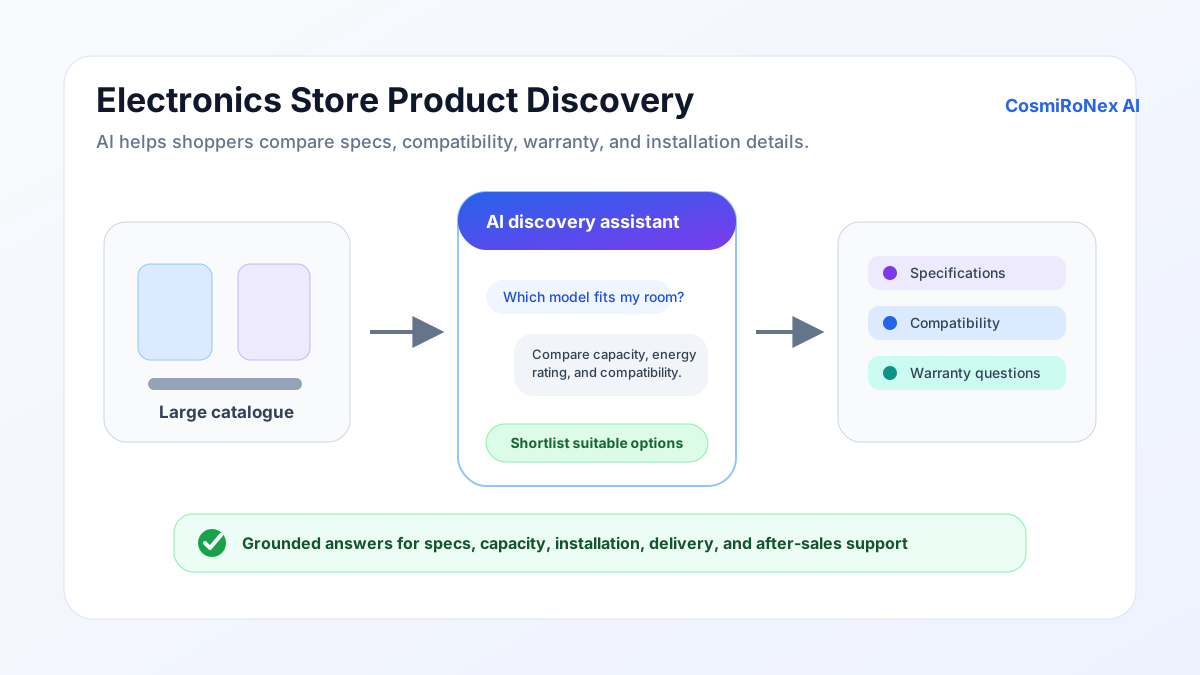
How AI addresses electronics discovery
An electronics or appliance store faces a customer discovery problem that is different in kind from most other retail categories. The products are technical, the specifications are numerous, the vocabulary is specialised, and the wrong choice is expensive to correct. A refrigerator that does not fit the available recess, a television with a refresh rate that does not suit gaming use, an air conditioner whose capacity is insufficient for the room — these are not minor inconveniences. They generate returns, exchanges and lost customer trust.
An AI assistant grounded in the store's uploaded product documents can help customers navigate this complexity at scale. It answers specification questions, compares models across relevant attributes, identifies suitability based on customer-provided context, and acknowledges the limits of the available information rather than guessing. This does not replace the specialist knowledge of an experienced staff member for complex decisions, but it reduces the burden on those staff members for the high volume of routine specification and suitability questions that consume floor time every day.
The large-SKU discovery problem
A mid-sized electronics retailer may carry hundreds of models across televisions, refrigerators, washing machines, air conditioners, microwave ovens and small appliances. A customer who arrives looking for a washing machine has, in theory, dozens of options. In practice, they have the attention span and patience to consider three to five before making a decision.
Getting from several dozen to three to five is the discovery problem. Traditional tools — on-shelf category signs, website filter dropdowns, staff guidance — all require either the customer or the staff member to engage directly with the catalogue. Staff time is finite; filter dropdowns require the customer to know which specifications matter for their use case; category signs operate at a level of abstraction that does not help with specific suitability questions.
The discovery problem is particularly acute for customers who are first-time buyers in a category, or who are replacing a product they have not thought about in many years. They know what outcome they want — clothes that come out clean, water that gets cold quickly — but they cannot easily map that outcome to the attributes listed on product specifications.
Catalogue-grounded product questions
When a customer asks the AI assistant about a specific product — "tell me about this model" or "what are the main features of this refrigerator?" — the assistant responds based on the information in the retailer's uploaded catalogue and specification documents. It does not draw from manufacturer marketing copy, external review sites or general internet knowledge.
This grounding means the response reflects what the retailer's own documents say about the product. If the uploaded catalogue describes the refrigerator's capacity, energy rating and shelf arrangement, the assistant can speak to those attributes. If the catalogue does not document a specific feature, the assistant acknowledges the gap rather than interpolating an answer.
For retailers, this behaviour means that uploading comprehensive, accurate product sheets is directly connected to the quality of customer responses. A product sheet that is missing key customer-relevant attributes — capacity, installation clearances, noise level — will produce responses that are less useful for decision-making.
Model and specification comparison
Comparing two models is one of the most common requests the AI assistant receives in electronics retail. A customer who has narrowed their choice to two washing machine models may want to understand how they differ across the specifications that matter for their specific situation.
The assistant can compare models across attributes documented in the retailer's uploaded data: drum capacity, spin speed, wash programme count, energy rating, noise level, dimensions and warranty duration are examples. The comparison is presented in the context of the customer's stated use case — a family of four with frequent laundry loads — rather than as a raw specification table.
Where models differ in a way that is directly relevant to what the customer has described, the assistant highlights that difference. Where models are similar across the attributes the customer cares about, it says so. Where the uploaded documents do not contain enough information to compare a specific attribute, it acknowledges the gap.
Suitability and compatibility questions
Beyond raw specification comparison, customers frequently ask about suitability for their specific situation. These are not questions that a specification table can answer directly:
- "Is this television suitable for a room that gets afternoon sun?"
- "Will this air conditioner be sufficient for a room of this size?"
- "Can this washing machine handle heavy bedding?"
- "Is this refrigerator suitable for a family of five?"
Suitability responses require the assistant to apply documented specifications to the context the customer has provided. For an air conditioner, the assistant uses the capacity information in the uploaded documentation and the room dimensions the customer has provided to give a relevant answer. It does not make engineering judgments that go beyond what the documentation supports.
Compatibility questions — "will this television remote work with a soundbar?" or "can this refrigerator door be rehung to open the other way?" — depend on whether the uploaded product documents address those specifics. If they do not, the assistant recommends confirming with a staff member or the product manual.
Energy-rating questions
Energy efficiency is a significant consideration for large-appliance purchases. Customers ask about energy ratings because they affect running costs over the life of a product.
The AI assistant addresses energy-rating questions based on the information in the retailer's uploaded product documents. If a product's energy rating is documented in the uploaded specifications, the assistant can report it and, where the customer has asked, describe what it means in practical terms based on the product documentation.
Where energy-rating information is absent from the uploaded product data, the assistant acknowledges this and recommends checking the product's physical label or confirming with a staff member.
Capacity and installation questions
For appliances, capacity and installation requirements are among the most practically important attributes. A refrigerator that does not fit the allocated kitchen recess is not suitable regardless of its other qualities. A washing machine with insufficient load capacity creates ongoing inconvenience.
The assistant addresses capacity and installation questions from the uploaded product specifications. Dimension data — height, width, depth, installation clearances — allows the assistant to respond directly when a customer provides their available space measurements. Capacity data — litres, kilograms, litres per cycle — provides the basis for suitability responses when a customer describes their household size or typical usage.
For installation requirements beyond dimensions — electrical supply requirements, plumbing connections, ventilation clearances — the assistant can provide what is documented in the uploaded specifications. Where the documentation is silent on a specific installation detail, the assistant recommends confirming with an installation professional or the product manual.
Warranty and delivery policy questions
Warranty questions are common for electronics and appliances because the warranty period and its terms are a direct factor in the total value of a purchase. Customers want to know how long coverage lasts, whether it covers parts and labour, and what the process is for a claim.
The assistant answers warranty questions based on the warranty information in the retailer's uploaded product documents and policy documents. It does not make commitments beyond what is documented — it reports what the uploaded documents say about the warranty for a specific product.
Delivery policy questions — timelines, available delivery areas, installation service inclusion — are similarly answered from uploaded store policy documents. If a delivery timeline is not documented for the customer's area or the question requires live logistics information, the assistant directs the customer to a staff member or the retailer's delivery tracking system.
After-sales questions
After-sales questions — about service centres, spare parts availability, consumables, or how to register a product for warranty — arise both from prospective buyers thinking ahead and from existing customers who have already purchased.
The AI assistant on the store's website or QR assistant can address after-sales questions from the retailer's uploaded documentation. Frequently asked after-sales questions — "where is the nearest service centre?", "can I get a replacement water filter for this model?", "how do I register for warranty?" — are suitable for inclusion in a product knowledge document that the retailer uploads alongside the product catalogue.
For complex after-sales situations — a specific repair quotation, a complaint about a recent service visit, or an escalation — the assistant facilitates a handoff to a staff member rather than attempting to address matters that require account-level knowledge or authority.
Website Widget, QR and Kiosk roles
Each deployment surface serves a distinct discovery context in electronics retail.
The Website AI Widget is most useful for pre-purchase research, where customers are browsing the retailer's online catalogue before deciding to visit the store or complete a purchase. It can handle comparison questions, specification queries, suitability assessments and delivery policy questions across the full online catalogue.
The QR Assistant is useful in physical retail environments — placed on shelf tags or product cards beside display models, it gives customers who are already in the store a way to get detailed specification information or comparison answers via their phone without waiting for a staff member.
The AI Kiosk is appropriate for larger electronics stores or appliance showrooms where customers spend extended time exploring categories. A kiosk in the major-appliances section provides a dedicated touchpoint for specification questions and model comparisons, reducing floor-staff demand during peak periods.
Limitations
- No current prices. The assistant reflects pricing in uploaded documents. Sale prices, promotional discounts and negotiated trade-in values require confirmation with a staff member.
- No live stock confirmation. Whether a specific model is currently in stock requires a real-time inventory check that is outside the scope of the AI assistant's uploaded documents.
- No installation commitment. The assistant provides documented installation requirements. Whether a specific installation is feasible for a customer's premises is a judgment for an installation professional.
- No energy-cost calculation. The assistant reports documented energy ratings but does not calculate projected electricity costs, which depend on local tariffs and usage patterns outside the retailer's documentation.
- No warranty commitment. The assistant reports warranty terms as documented. Warranty claims and their outcomes depend on the manufacturer's and retailer's service processes, which are separate from the AI assistant.
- External specifications not accessed. The assistant does not access manufacturer websites or external review databases. It responds from retailer-provided documents only.
Website Widget product demonstration
Related articles
Ready to explore how CosmiRoNex AI works for your retail business?
Explore AI solutions for electronics and appliance retailers