
How to Measure the ROI of an AI Sales Assistant for Retail
Use a practical framework to measure AI sales assistant value through engagement, qualified leads, staff time, assisted sales and total cost.
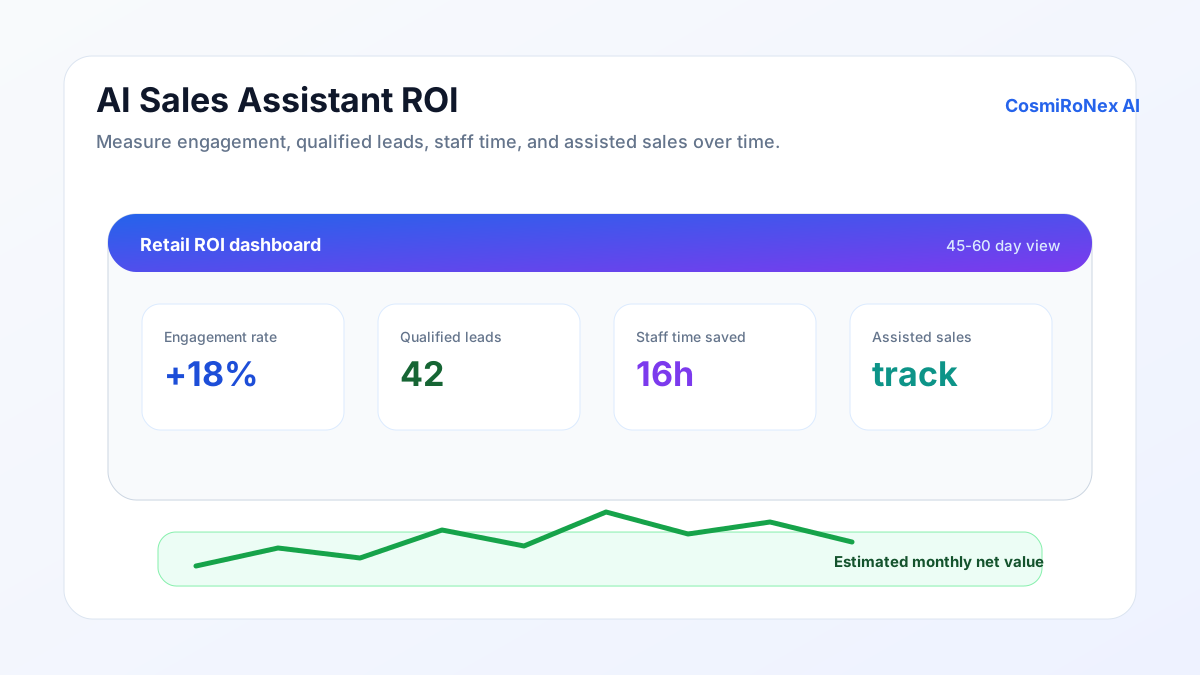
How to approach ROI measurement
Measuring the return on an AI sales assistant is possible, but it requires a clear framework, realistic expectations about what can be directly attributed, and a distinction between the figures a short pilot can establish and the figures that only emerge over sustained deployment.
This article provides a framework for thinking through that measurement. It defines the metrics, describes the formulas used to combine them, identifies the costs that should be included in a full cost of ownership, and works through an illustrative fictional scenario that demonstrates how the numbers connect. It does not provide benchmark targets or guaranteed return timelines — those depend on each store's specific situation.
Why attribution is difficult
In most retail settings, the path from an AI assistant interaction to a completed sale is not a straight line. A customer might engage with the website widget on a Tuesday, visit the showroom on a Thursday, speak with three staff members, and purchase on a Saturday. The AI interaction contributed to the journey, but it is one of several influences — and capturing that contribution accurately requires deliberate tracking.
Attribution is further complicated by the fact that a customer who did not engage with the AI assistant might have purchased anyway. Without a controlled comparison — which is difficult to arrange in a live retail environment — it is not possible to know with certainty what share of purchases were genuinely influenced by the AI, versus purchases that would have occurred regardless.
The practical response to this difficulty is to use conservative attribution. An "assisted sale" is recorded only when there is a verifiable link — for example, the customer mentioned the AI conversation to the salesperson, or the lead was captured through the AI assistant and the purchase can be traced to that lead record. Conservatively attributed assisted sales produce a more credible ROI figure than broadly claimed ones.
Key definitions
Before calculating any ROI metric, agree on consistent definitions within the business. Different interpretations of the same term produce numbers that cannot be compared across periods or across stores.
- Engaged visitor: A website visitor or in-store customer who sent at least one substantive message to the AI assistant and received a response. Brief accidental interactions (a single-word message or an immediate exit) may be excluded based on a minimum interaction threshold the business sets in advance.
- Qualified lead: A customer who provided contact information voluntarily through the AI assistant — name, phone number or email — with an expressed interest in a specific product, service, visit or callback.
- Followed-up lead: A qualified lead that was contacted by a staff member within a defined response window — for example, within 24 hours on a weekday.
- Assisted sale: A completed purchase that can be verifiably linked to a prior AI assistant interaction — through lead tracking, customer-reported AI interaction, or a documented referral path.
- Staff-time value: The estimated monetary value of staff hours freed by AI handling of routine enquiries — calculated from average staff cost per hour and an estimate of time displaced.
Visitor engagement rate
The visitor engagement rate measures what proportion of visitors to the AI-enabled surface actually used it.
Total visitors is the count of unique sessions on the page where the widget is present, or the number of QR code scans, or the number of kiosk sessions started — depending on the surface being measured. Engaged visitors is the count of sessions that included at least one substantive AI interaction, using the definition agreed above.
The engagement rate will vary significantly by surface placement, product category, and how prominently the AI assistant is presented. A widget that is minimised by default and requires the customer to actively open it will produce a lower engagement rate than one that opens with a relevant prompt. Neither is inherently better — they reflect different design choices with different trade-offs.
There is no universal benchmark for what constitutes a good engagement rate. The relevant question is whether the rate improves over time as the product documents are improved and the presentation is refined.
Qualified lead rate
The qualified lead rate measures what proportion of customers who engaged with the AI assistant converted into a qualified lead by providing contact information.
Not every customer who engages with the AI assistant will provide contact details. Many will get the information they need and leave — either to return later, or not at all. The qualified lead rate reflects the proportion who were both helped by the assistant and motivated to take the next step.
The qualified lead rate is influenced by the design of the lead-capture moment — where in the conversation it appears, how it is framed, and what the customer is being asked to do next. A lead-capture prompt that is too early (before the customer has received value) or too intrusive (requiring too many fields) will suppress this rate.
Follow-up rate
The follow-up rate measures what proportion of qualified leads were actually contacted by a staff member within the defined response window.
A high lead-capture rate combined with a low follow-up rate indicates a process failure — leads are being generated but not acted on. This is one of the most common measurement mistakes in AI sales assistant deployments. The technology delivers the lead; the commercial outcome depends on the staff follow-up process.
The follow-up rate should be tracked separately for different lead types (test-drive interest, quotation request, product enquiry) and for different response windows (same day, next day, within 48 hours). A deteriorating follow-up rate is an early warning that the lead volume is exceeding the team's capacity to respond.
Assisted-sales tracking
Assisted-sales tracking is the most commercially significant — and most operationally demanding — measurement task. It requires a link between a specific AI interaction or lead record and a completed sale.
The practical methods for creating this link depend on the store's systems. Where a CRM is in use, leads captured by the AI assistant can be tagged in the CRM, and sales traced to those leads counted as assisted. Where a CRM is not in use, a simpler approach is to ask sales staff at the point of sale whether the customer mentioned using the website assistant or arrived with a specific model question that the salesperson did not initiate — and recording this as a proxy for AI-assisted engagement.
Neither method is perfect. CRM-based tracking can miss customers who engaged with the AI but did not leave contact details before purchasing. Self-reported tracking is subject to recall and recency bias. The appropriate response is to use whichever method is feasible and apply it consistently, rather than to delay measurement until a perfect tracking system is available.
Assisted gross profit
Assisted gross profit is the gross profit generated on the sales attributed to the AI assistant over a measurement period.
The average gross profit per assisted sale should reflect the actual margin on the product mix that the AI assistant engages with. If the assistant primarily engages with customers in a high-margin category, the average gross profit figure will differ from a deployment that primarily supports a lower-margin category.
Use gross profit rather than revenue in this calculation. Revenue-based ROI calculations overstate the return unless the full cost of goods is separately accounted for.
Staff-time estimation
Staff-time value captures the economic benefit of staff hours freed by the AI assistant handling routine enquiries that would otherwise have occupied a staff member.
Estimating this requires two inputs: the average cost per staff hour (including salary and benefits, not just base pay) and an estimate of the average time the AI assistant displaces per engaged customer. Both inputs require judgment — the second especially, since many AI-handled interactions would simply not have happened at all (the customer would have left without asking) rather than being handled by a staff member.
A conservative estimate focuses on interactions that demonstrably displaced staff time: situations where a customer used the AI assistant while a staff member was available nearby but occupied. A broader estimate includes all AI interactions on the assumption that any engaged customer represents a potential demand on staff attention. The conservative approach produces a more defensible figure.
Platform cost
Platform cost is the subscription or usage fee for the AI assistant service. This is a fixed, known cost that should be included in any ROI calculation. It is typically charged monthly or annually and should be expressed on a consistent time basis when calculating net value.
Platform cost should be the actual fee agreed with the provider. Do not use a generic estimate or a figure published in a case study that may not reflect current pricing or the specific configuration of your deployment.
Implementation cost
Implementation cost covers the one-time investments required to deploy the AI assistant: configuration time, initial product document preparation, staff training, widget integration on the website or QR code printing for the showroom. These costs are incurred once and should be amortised over a reasonable deployment period — typically 12 months — rather than charged in full against the first month's figures.
A deployment that requires extensive document preparation — writing detailed product specifications from scratch — will have a higher implementation cost than one where the retailer already has well-organised product documentation. Retailers with existing catalogues in digital format typically have lower implementation costs.
Content-maintenance cost
Content-maintenance cost covers the ongoing effort of keeping product documents current. When new models are added, old models are discontinued, prices change or policies are updated, the uploaded documents need to be revised. A deployment whose product data is never updated will produce increasingly inaccurate responses over time.
Maintenance cost should reflect actual staff time spent on document updates, not an aspirational estimate. For a retailer with a stable, slowly-changing catalogue, this may be a small monthly effort. For a retailer with frequent new arrivals or regular promotional pricing changes, the effort is higher.
Including maintenance cost in the ROI calculation prevents the common error of comparing initial-deployment performance (before the content becomes stale) with sustained costs that do not include the effort needed to maintain that performance.
Estimated monthly net value
Combining the benefit estimates and the cost components gives an estimated monthly net value — the bottom-line figure that indicates whether the AI assistant is commercially justified for the business.
This formula captures the commercial benefit (assisted gross profit), the operational benefit (staff-time value) and all three cost categories. A positive net value indicates that the deployment is generating more value than it costs. A negative value indicates that adjustments are needed — which may be in the revenue attribution, the lead follow-up process, the document quality, or the cost structure.
The net value figure should be treated as an estimate, not a precise accounting figure. The benefit components (particularly assisted gross profit and staff-time value) involve attribution judgments that are inherently approximate. The value of the formula is not precision — it is the structured thinking it forces about where the value comes from and what the costs are.
Illustrative scenario
A fictional mid-sized furniture showroom receives 800 website visitors per month and 400 in-store QR code scans. Using a fictional engagement rate of 12% on the website and 20% on QR, they have 96 website-engaged visitors and 80 in-store-engaged visitors per month — 176 total engaged visitors.
Using a fictional qualified lead rate of 25%, they capture 44 qualified leads per month. With a fictional follow-up rate of 80%, staff contact 35 of those leads. Using a fictional assisted sales rate of 15% on followed-up leads, they record approximately 5 assisted sales per month. At a fictional average gross profit of ₹18,000 per sale, the assisted gross profit is approximately ₹90,000 per month.
Adding a fictional staff-time value of ₹8,000 per month (based on estimated displaced enquiry time), the total monthly benefit estimate is approximately ₹98,000.
Subtracting a fictional platform cost of ₹12,000, amortised implementation cost of ₹3,000, and content-maintenance cost of ₹2,000, the estimated monthly net value is approximately ₹81,000.
Which assumption most changes this result? The assisted sales rate is the most sensitive input. Changing from a fictional 15% to a fictional 8% reduces the gross profit estimate to approximately ₹48,000 and turns the net value negative under this fictional cost structure. Retailers should test their attribution assumptions carefully before presenting ROI figures to stakeholders.
What a 7-day pilot can and cannot establish
A 7-day pilot produces useful early signal but has significant measurement limitations.
What a 7-day pilot can establish: whether the AI assistant engages the target customer type; whether the product documentation produces useful responses; whether the lead-capture flow works technically; whether staff can access and act on leads from the system; and whether there are obvious content or configuration problems that need fixing before sustained deployment.
What a 7-day pilot cannot establish: whether assisted sales occur at a meaningful rate (most sales cycles are longer than 7 days in high-consideration retail); what the staff-time value is over a realistic volume; whether engagement rates are stable or subject to novelty effect; or whether the document quality is adequate for the full range of customer questions the assistant will receive at scale.
Retailers who make deployment decisions based solely on a 7-day pilot are measuring a setup check, not a business outcome. Sustained measurement over 45–60 days produces figures that are more meaningful for a genuine deployment decision.
What to measure over 45–60 days
A 45–60 day measurement period allows enough time for the sales cycle to complete for customers who first engaged with the AI assistant in the early weeks. It also allows engagement patterns to stabilise beyond any novelty effect from a new deployment.
Over this period, track monthly:
- Engaged visitor count and engagement rate, by surface.
- Qualified lead count and qualified lead rate.
- Follow-up rate and average response time.
- Assisted sales count, using the attribution method agreed at the outset.
- Customer questions the assistant could not answer — to identify document gaps.
- Staff feedback on the quality of leads and the usefulness of lead context.
Reviewing these metrics monthly allows the retailer to identify whether performance is improving (as product documents are refined), stable (suggesting a sustainable baseline), or deteriorating (suggesting document staleness, process breakdown, or seasonal factors).
Intangible benefits
Not all value from an AI sales assistant appears in the net value formula. Some benefits are real but difficult to quantify without extensive research.
- Customer experience outside business hours. A customer who gets a useful answer at 11pm may return the next day ready to purchase. The value of after-hours engagement is real but hard to attribute in most retail tracking systems.
- Reduced staff stress during peak periods. When staff are not occupied answering the same basic specification questions repeatedly during a busy Saturday, they may be more effective with the customers who need specialist attention. This is difficult to measure but is reported as an operational benefit by retailers who deploy AI assistants.
- Improved document quality as a by-product. The process of preparing and maintaining product documents for the AI assistant often reveals inconsistencies, gaps and outdated information in the retailer's existing catalogue. Improving this documentation benefits staff and other customer channels, not just the AI assistant.
- Brand signal. An AI assistant that works well reflects positively on the retailer's investment in customer service infrastructure. Whether this translates into a measurable commercial effect is not established.
Common measurement mistakes
- Measuring engagement rate as the primary success metric. Engagement rate tells you how many people used the assistant, not whether the usage produced commercial value. A high engagement rate with a low lead rate or a low follow-up rate indicates a problem in the conversion path, not a success.
- Not tracking follow-up rate. Lead capture without follow-up does not produce commercial outcomes. Retailers who measure leads captured but not leads followed up will overestimate the commercial effectiveness of the deployment.
- Using revenue instead of gross profit. Revenue-based ROI comparisons inflate the apparent return unless cost of goods is separately deducted. Use gross profit to produce a comparable basis for the net value calculation.
- Attributing too broadly. Counting every sale that occurred in a month where the customer had any AI interaction overstates the AI's contribution. Use a conservative attribution definition agreed before deployment begins.
- Omitting implementation and maintenance costs. Comparing gross assisted profit to platform cost alone, without including the staff time required to implement and maintain the deployment, produces an overstated net value.
- Measuring too early. A measurement period shorter than 45 days in high-consideration retail categories is unlikely to capture a meaningful number of completed sales cycles. Use a pilot to establish configuration quality; use 45–60 days to measure business outcomes.
Expansion decision
After a sustained measurement period, a retailer has enough data to make a structured expansion decision. The relevant questions are:
- Is the estimated monthly net value positive after including all cost categories?
- Is the follow-up rate high enough to justify increasing lead volume through expansion?
- Are there surfaces or product categories not yet covered that show potential — for example, QR codes on all display vehicles when only the website widget is currently deployed?
- Have the highest-volume unanswered questions been addressed in the product documents, reducing the proportion of interactions that produce an "I don't have that information" response?
Expansion that doubles surface coverage without addressing the underlying product document quality will produce proportionally more engagements with proportionally similar gaps. Invest in document quality first, then scale the surface coverage. The combination of better documentation and broader deployment produces better commercial outcomes than either alone.
The expansion decision should also consider staff capacity. An expansion that doubles qualified lead volume in a month requires the sales team to have sufficient capacity to follow up those leads within the response window. A deployment that generates more leads than the team can contact is less commercially effective than a smaller deployment with a high follow-up rate.
Platform overview — general context
Related articles
Ready to explore how CosmiRoNex AI works for your retail business?
Book a free demo and discuss how to measure results