
How Retail Stores Can Capture Leads When Sales Staff Are Busy
Learn how retail stores capture qualified enquiries during busy hours using QR assistants, website widgets and clear follow-up workflows.
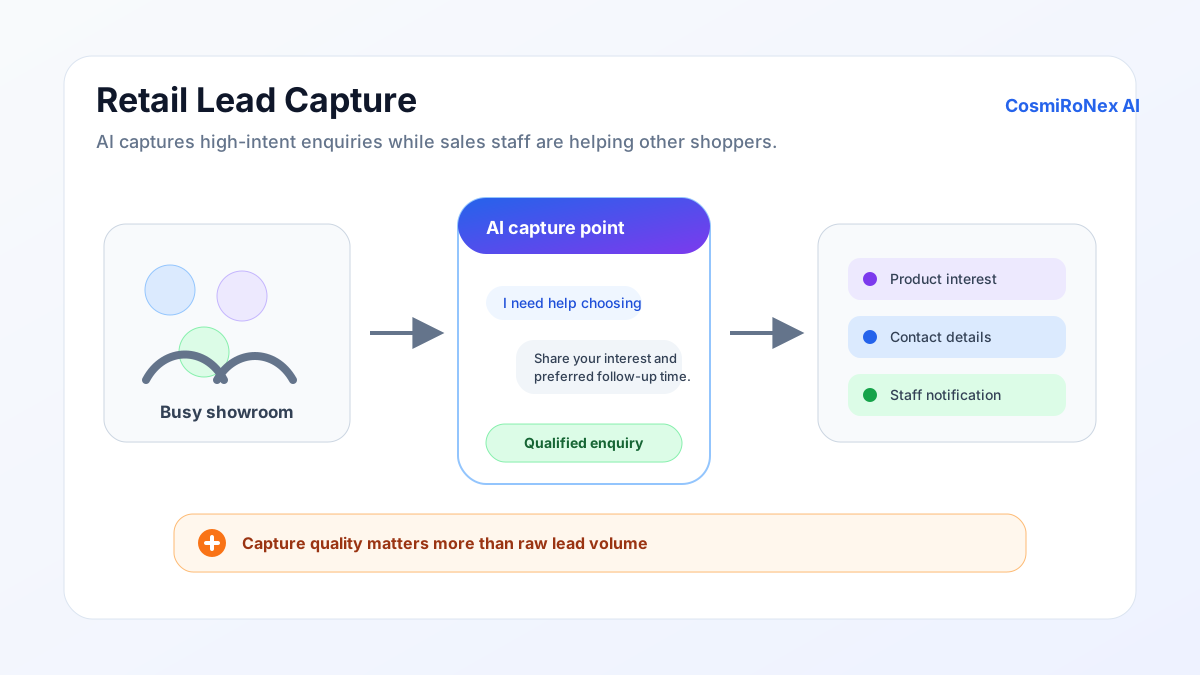
What happens when customers cannot get attention
Walk into a busy automobile showroom on a Saturday afternoon and the picture is familiar: every salesperson is occupied with another customer, a couple is waiting near a vehicle they are interested in, and two or three others are browsing independently without any direction. Eventually, the waiting customers run out of patience. They photograph a brochure for reference, make a mental note to return, and leave.
In most cases, they do not return. The mental note does not survive the drive home and the next errand. The store has no record of who these visitors were, what they were interested in, or how close they were to making a decision. From the store's perspective, they were part of the footfall count — but nothing more.
This is the lead capture problem: the gap between a customer who visited with genuine interest and the store's ability to follow up on that interest. Staff being busy is one of the most common reasons this gap exists, but it is not the only one. After-hours website visits, weekend showroom browsing, and customers who prefer not to approach a salesperson immediately all create the same gap.
Missed enquiry versus anonymous footfall
There is a useful distinction between a missed enquiry and anonymous footfall. Anonymous footfall is a visitor who browsed without engaging — no question asked, no product examined closely, no sign of specific intent. These visitors may have entered the store out of curiosity or by accident; the store's ability to convert them to leads is inherently limited.
A missed enquiry is different: a visitor who showed specific intent — stopped at a particular vehicle, examined a product closely, picked up a brochure — but left without making contact because no staff member was available at the right moment. This is an enquiry that the store could have captured and did not.
The AI assistant creates a way for those high-intent visitors to self-identify. A QR code on the vehicle they were examining, or a website widget they were using at midnight, becomes a channel through which they can ask questions and voluntarily submit their contact details — without needing a salesperson to be present.
Two capture points: QR and Website Widget
CosmiRoNex AI provides two surfaces that serve as lead capture points in different contexts.
QR Assistant in the showroom
A QR code placed on or beside a product gives in-showroom visitors access to the AI assistant without waiting for staff attention. The customer scans, explores the product, asks questions, and can submit their details if they want a follow-up. This captures enquiries from visitors who are physically present but cannot or prefer not to wait for a salesperson.
Website AI Widget for online visitors
Many purchase journeys begin online — customers research before visiting a showroom or making a purchase decision. The Website AI Widget captures enquiries from these visitors at the moment of highest engagement: when they are actively researching a specific product on the store's website. At that moment, the customer is invested enough in the product to ask specific questions; offering a way to leave their details for a follow-up meets them at the right stage.
Both surfaces work with the same knowledge base and the same lead capture workflow. The difference is the physical context: QR for in-showroom capture, website widget for online capture.
What makes a qualified lead
A qualified lead, in the context of retail AI capture, is one where the customer has demonstrated specific intent beyond browsing. Characteristics that signal qualification:
- The customer asked about a specific product, model, or configuration rather than a broad category.
- The customer enquired about pricing, availability, delivery timelines, or financing — questions that indicate a decision is being considered.
- The customer voluntarily submitted their contact details with a clear follow-up request: "Call me," "Send me a quote," or "I want to schedule a test drive."
The AI assistant captures the context of the conversation alongside the contact details. A staff member following up on a lead who asked "Is the 2024 variant available with a diesel engine and sunroof?" can have a much more targeted conversation than one following up on a generic "I am interested" contact form submission.
Lead quality versus lead quantity
A common early expectation from AI lead capture is volume: the tool will generate more leads than the manual approach. This is possible, but the more important objective is quality — leads with enough context and intent that a follow-up call has a reasonable chance of progressing.
A system configured to ask every visitor for contact details immediately — before any product interaction has taken place — may generate volume, but the leads will have low context and unverified intent. The customer submitted their details because they were asked to, not because they had reached a decision point.
A system that invites contact submission after the customer has explored a product, asked several questions, and reached a point of genuine interest produces fewer leads but ones where the follow-up conversation has a real starting point. For high-ticket retail, the sales team's time is finite; quality over quantity is generally more productive.
Consent and privacy-conscious capture
Retail AI lead capture involves collecting personal information — names, phone numbers, email addresses. How that collection is handled affects both customer trust and the store's legal obligations.
The AI assistant captures contact details only when the customer actively submits them. There is no hidden contact-data collection; the customer must take a deliberate action — typing their details into a form field — for any personal information to be recorded. The assistant does not infer, extract, or record contact information from the body of a conversation.
The lead capture form in the assistant makes clear what information is being collected and why. Customers are not pressured or misled into submitting their details; the invitation to leave contact information is presented as an option, not a requirement to continue the conversation.
Staff notification and follow-up workflow
A captured lead has no value if it is not followed up. The most common failure mode in retail lead capture is not the capture itself but what happens after: the lead sits in a system that staff do not check regularly, or arrives in an inbox that nobody owns, and the follow-up happens days later — if at all.
CosmiRoNex AI provides staff notification for incoming leads. The specific mechanism — email, dashboard notification, or integration with an existing CRM — depends on the store's configuration. What matters operationally is that someone on the team is responsible for acting on leads within a defined timeframe and has the tools to do so.
A basic follow-up workflow assigns clear ownership (which team member handles new leads), a response time target (how quickly a lead should receive a first contact), and a qualification step (a brief call to confirm the customer's current interest before a longer conversation or showroom visit is arranged).
The AI assistant hands off to this workflow; it does not automate the follow-up conversation itself. The quality of the follow-up is a human responsibility.
Common mistakes in retail lead capture
- Asking for contact details before delivering value. If the first thing the assistant does is ask for a phone number, customers will disengage. The capture invitation is most effective after the customer has received useful answers and is at a natural decision point.
- Treating all leads identically. A customer who asked a single generic question and a customer who researched three specific models and asked about financing are at very different stages. Responding to both with the same script misses the context that AI capture makes available.
- Neglecting the follow-up response time. A lead submitted while a customer is standing in the showroom is far more valuable in the next ten minutes than the next two days. Delayed follow-ups lose the context of the live visit.
- Not updating the knowledge base. If the AI assistant cannot answer the questions customers are actually asking — because the product information is incomplete or outdated — it will not capture their interest. The knowledge base quality is the foundation of lead quality.
- Capturing without consent clarity. Customers who feel that they were tricked into submitting their details, or who receive unexpected communications that they did not explicitly request, are likely to disengage from the store entirely.
What AI capture cannot do
- The AI supports staff — it does not replace them. The AI assistant handles the information stage and captures intent. Closing a sale, negotiating terms, and building the personal trust that drives high-value purchases require a staff member.
- The AI does not close a sale. Submitting interest through the assistant is the beginning of the sales conversation, not the end. There is no automated path from AI interaction to purchase completion.
- The AI does not guarantee a follow-up. The assistant captures the lead and notifies the store team. Acting on that lead is a human responsibility and depends on the store's follow-up process.
- Customer intent cannot be verified by the AI. Some visitors will submit contact details without serious purchase intent. Qualifying that intent requires a brief human conversation.
QR Assistant product demonstration
Related articles
Ready to explore how CosmiRoNex AI works for your retail business?
See how the QR Assistant captures customer interest