AI Video Avatar vs Traditional Chatbot: What Is the Difference?
Compare text chatbots, voice assistants and AI video avatars for retail, including use cases, setup needs, language support and limitations.
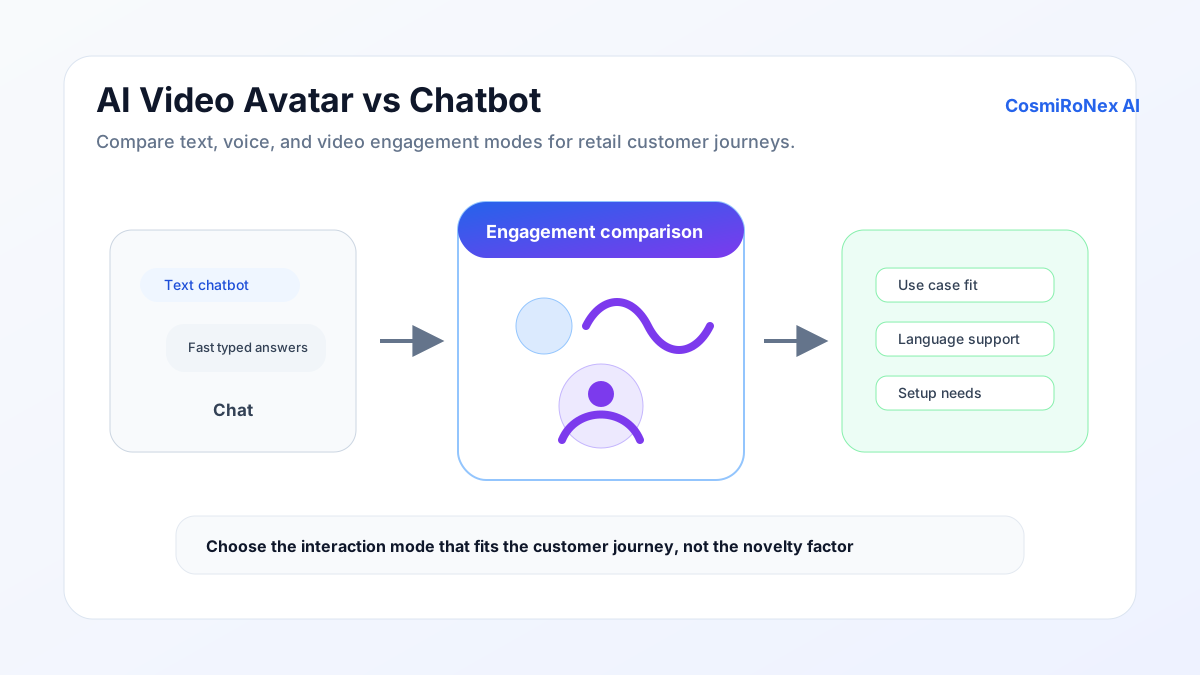
Three ways AI can engage retail customers
When a retail business deploys AI to assist customers, the interface that the customer sees matters — not only for aesthetics, but for the kind of interaction it enables and the customers it is likely to work well for. CosmiRoNex AI offers three distinct engagement modes, each with different characteristics.
Understanding the differences between a traditional text chatbot, a voice-based AI assistant, and an AI video avatar helps businesses choose the right surface for their customer context — and avoid over-investing in features that their specific customer base may not use.
Traditional text chatbot
A traditional text chatbot presents a chat panel — usually in the corner of a website or embedded in a kiosk screen — where the customer types questions and reads text responses. It is the oldest and most widely understood format for AI-assisted customer interaction.
Text chat is familiar, low-bandwidth, and works on all devices. It does not require the customer to speak aloud, which makes it appropriate for environments where privacy or ambient noise is a consideration: an open-plan office, a quiet showroom, or a late-night browsing session at home.
The quality of a text chatbot's responses depends almost entirely on the knowledge base it is given. A chatbot with thin or outdated product documentation produces vague, generic answers. The same chatbot with comprehensive, well-maintained content produces precise, useful ones. The interface is neutral; the knowledge base is what differentiates a useful deployment from a frustrating one.
Text chat also supports Hindi as well as English, making it accessible to customers who prefer to communicate in Hindi.
Voice-based AI assistant
A voice-based AI assistant accepts spoken questions and responds in speech. The customer speaks into their device microphone; the AI processes the question and returns an audible answer. This is sometimes called an "advanced voice" experience to distinguish it from simple text-to-speech output.
Voice-to-voice conversation reduces the friction of typing, which is particularly useful on a mobile screen or at a kiosk where typing is less comfortable. It also suits customers who communicate more naturally by speaking than by writing.
Advanced voice-to-voice is currently an English-language experience within CosmiRoNex AI. Read-aloud — where answers to text questions are spoken aloud — is a separate capability that can be used alongside English and Hindi text chat where enabled, but is distinct from full voice-to-voice conversation.
AI video avatar
An AI video avatar presents a human-like on-screen figure that speaks responses directly to the customer. Rather than reading text in a chat panel or listening to a disembodied voice, the customer sees and hears a presenter who delivers the AI-generated answer in video form.
The AI Video Sales Consultant is CosmiRoNex AI's implementation of this experience. It combines video avatar presentation with the same knowledge base and AI response engine used across other surfaces. The avatar does not independently negotiate prices, make commitments, or take actions outside the interaction — it presents information from the knowledge base in a visual format.
The AI video avatar is currently an English-language experience. Customers who prefer to interact in Hindi are better served by the text-based or read-aloud surfaces, which support text conversations in English and Hindi.
Side-by-side comparison
Engagement style
Text chat is quiet and private — suited to customers who prefer to read at their own pace. Voice is conversational and hands-free. Video is presentational and personal — it is closer to watching a demonstration than reading a specification sheet.
Infrastructure requirements
Text chat has the smallest infrastructure footprint — it runs on any device with a browser. Voice requires microphone access and stable audio. Video requires more bandwidth and a higher-specification device for a smooth playback experience. A kiosk or website running a video avatar should have a reliable broadband connection.
Language support
Text chat supports English and Hindi, with read-aloud where enabled. Advanced voice-to-voice and the AI video avatar are currently English-language experiences. For businesses serving Hindi-speaking customers, text chat is currently the more comprehensive option. Other Indian languages are not currently supported.
Setup requirements
All three approaches use the same underlying knowledge base — the same uploaded product and policy content. The additional setup for voice involves microphone permission configuration. The additional setup for the video avatar involves the branding and configuration of the avatar experience itself. Text chat has the shortest setup path.
Customer comfort
Customer comfort varies by demographic, device familiarity, and environment. In general, text chat has the broadest comfort level across age groups and technical literacy. Voice and video may require brief orientation for customers who have not used similar interfaces before.
When text chat is the right choice
Text chat is appropriate for most deployments as the primary or default interaction mode. It works well when:
- The customer base spans a wide range of ages, device types, and language preferences.
- Hindi as well as English support is a priority.
- The store wants to deploy quickly and validate the knowledge base before investing in voice or video features.
- The environment is one where spoken interaction is not practical — a quiet showroom, a shared browsing context, or an after-hours website visit.
Starting with English and Hindi text chat and evaluating what percentage of customers engage with it, which questions they ask, and where the knowledge base has gaps is a sound foundation before deciding whether voice or video adds meaningful value for a specific store's context.
When video adds genuine value
A video avatar can make a difference when the product category benefits from a more personal, consultative presentation style. High-consideration purchases — vehicles, jewellery, premium furniture, consumer electronics with complex specifications — involve customers who want guidance, not just information retrieval.
A well-configured AI video avatar can present these options in a manner that feels closer to a conversation with a product specialist than to reading a page of specifications. For brands where presentation quality is part of the retail experience, the video format reinforces the premium nature of the purchase.
Video also works well at a kiosk in a high-footfall environment where the display needs to attract attention and engage walk-in visitors. A moving, speaking figure is more visually prominent than a static text panel.
The practical threshold for choosing video is whether the improvement in customer experience justifies the additional configuration and bandwidth requirements for the specific deployment context.
What no approach can guarantee
- None of the three approaches closes a sale independently. The AI supports the customer's information and evaluation stage. Purchase decisions — especially for high-value items — involve staff consultation, negotiation, and in-person verification that no AI interface replaces.
- The avatar does not negotiate or make commitments. It presents information from the knowledge base. Pricing, availability, and terms must be confirmed with the store team.
- Accuracy depends on uploaded content. All three surfaces answer from the same knowledge base. If product or policy information is outdated or incomplete, the responses will reflect those gaps regardless of the interface used.
- Customer response to video varies. Not all customers will engage positively with an AI avatar. Some prefer text. A deployment that forces video on customers who would rather type may reduce engagement rather than increase it.
Choosing for your business
A practical set of questions to guide the decision:
- Is Hindi support a priority? If yes, text chat and read-aloud should be the foundation — text chat supports English and Hindi.
- Is the customer base primarily English-speaking? If yes, voice and video avatar become more practical options, since both are currently English-language experiences.
- Does the product category benefit from consultative presentation?Automobiles, jewellery, premium electronics — yes. Commodity items where price is the primary decision factor — probably not.
- Is the environment suitable for video or voice? A noisy showroom floor may not suit voice well. A shared screen visible to multiple customers at once may not suit video in the same way as a personal device interaction.
- Is the knowledge base strong enough to support the chosen format?A video avatar presenting incomplete information does not perform better than a text chatbot with the same gap. The knowledge base is the foundation; the interface is the wrapper.
For most new deployments, the practical starting point is an English and Hindi text assistant with well-maintained product content. Voice and video features can be added as the knowledge base matures and customer engagement patterns become clear.
Platform overview — general context
Related articles
Ready to explore how CosmiRoNex AI works for your retail business?
Explore the AI Video Sales Consultant