Multilingual AI Assistants for Indian Retail Businesses
How English and Hindi text chat and read-aloud reduce language friction in Indian retail — and how they differ from English-only voice and video experiences.
What multilingual AI assistants offer
In Indian retail, the customer who walks through the door — or arrives at a website — may be most comfortable in a language that is different from the language in which the store's marketing and product content is written. A staff member who shares the customer's language can bridge that gap naturally. When staff are busy, absent or unfamiliar with the customer's preferred language, the gap persists.
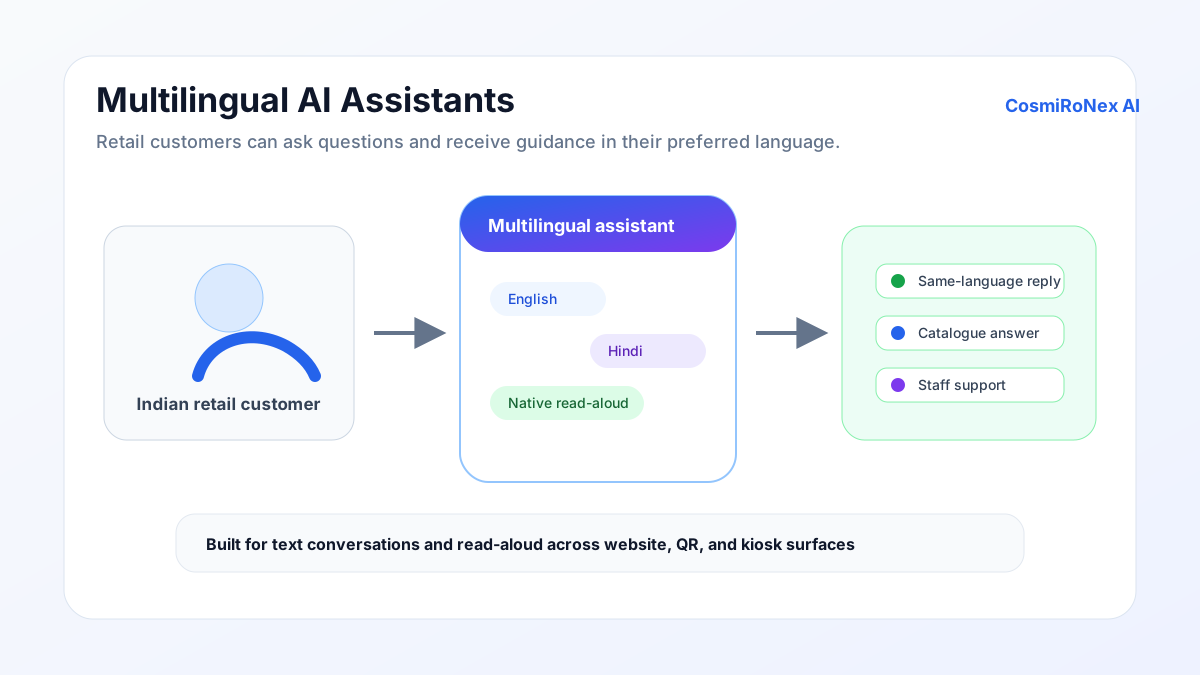
CosmiRoNex AI currently supports text conversations in English and Hindi. English is available on every assistant; Hindi is available where it has been enabled for that Website Widget or QR Assistant. Other Indian languages are not currently available to shoppers. Customers can ask product questions, get suitability guidance, and read responses in a language they find natural — without requiring a language-matched staff member to be available at that moment.
This is not a translation tool layered on top of English content. It is a system that accepts a question in English or Hindi and responds in that same language, drawing from the retailer's uploaded product documents. The experience is designed to feel conversational, not like a translated FAQ.
Language variation in Indian retail
India's linguistic landscape means that a single retail chain operating across several states may serve customers whose preferred languages differ significantly from region to region, and even from neighbourhood to neighbourhood within a city.
A showroom in one city may primarily serve customers who prefer to converse in one regional language, while a nearby location may serve a customer base with a different preference. Online channels may reach customers across multiple states simultaneously. The staff at any one location may speak two or three languages fluently — but not necessarily every language a walk-in customer might prefer.
This creates a practical gap. A customer who feels less confident expressing a technical question in English — "what is the energy star rating of this model?" or "does this sofa come in the darker fabric?" — may not ask the question at all, or may leave with less information than they needed to make a decision. Language accessibility directly affects how much of a product a customer feels able to explore.
What multilingual text chat means
In CosmiRoNex AI, multilingual text chat means that a customer who opens the chat panel — whether on a website widget, a QR assistant or a kiosk pilot — can type in English or Hindi and receive a response in that same language.
English and Hindi are the languages currently available to shoppers. Other Indian languages are not currently supported, so a customer expecting to interact in another language will not receive a response in that language.
Text conversations are the broadest multilingual capability. They do not require voice input from the customer or text-to-speech output — they are a standard typed interaction conducted in the customer's preferred language.
Same-language responses
When a customer writes in Hindi, the AI assistant responds in that same language. It does not switch to English and ask the customer to accept a translation, and it does not mix languages within a single response unless the product data itself contains mixed content — for example, a brand name or technical abbreviation that has no direct equivalent in the response language.
The quality of a same-language response depends in part on how the retailer's product documents are structured. If the uploaded catalogue is in English only, the AI assistant uses that content as the source and generates a response in the customer's language. If the retailer has uploaded documents in the customer's language directly, the assistant has access to more precise source material.
Native-language read-aloud
Where enabled, read-aloud allows customers to hear the AI assistant's response spoken aloud through their device speaker, in the language in which the response was generated. Voice and read-aloud availability depends on the enabled voice mode and browser.
This capability is most relevant in two situations. First, where literacy in a specific script is lower than spoken fluency — a customer who is comfortable speaking and listening in a language may find it easier to receive a read-aloud response than to read a text response in that script. Second, in physical retail environments — beside a vehicle in a showroom, at a kiosk in a large store — where reading a screen while simultaneously looking at a product is awkward.
Read-aloud is a configured capability, not universally enabled for all deployments. Whether a specific retailer's deployment includes read-aloud depends on the configuration set for that store.
Website, QR and Kiosk use cases
Website Widget
The Website AI Widget is typically the primary surface for multilingual support in e-commerce and D2C contexts. Customers from different regions arrive at the same website; a widget that accepts English or Hindi reduces the friction of needing to comprehend product descriptions in a language they find less natural.
QR Assistant
In a physical showroom or store, the QR Assistant gives in-store customers access to product information in English or Hindi via their own phone. A customer in an automobile showroom who prefers to engage in Hindi can scan a QR code beside a vehicle, ask questions, and receive responses — including read-aloud where enabled — in that language without requiring a language-matched staff member to be present.
AI Kiosk
A kiosk in a high-traffic showroom or store can be configured for multilingual text interaction. Customers who approach the kiosk can interact in English or Hindi. Read-aloud via the kiosk's speaker is a deployment option; it is most appropriate in environments where the ambient noise level allows customers to hear clearly.
Staff-support value
Multilingual AI capability does not replace language-skilled staff — it reduces the frequency with which those staff need to be immediately available for routine product questions. A staff member who speaks a customer's preferred language remains the best option for complex negotiations, complaints, customisation discussions and high-value decision support.
What the AI assistant can handle is the volume of product information queries that occur throughout the day: "what is the capacity of this model?", "does this come in a different colour?", "what is the warranty period?". Handling these in English or Hindi means those staff members are less frequently interrupted by language-barrier situations and can be directed to the conversations where their expertise genuinely adds value.
Content preparation and document quality
Multilingual responses are generated from the same product documents the retailer uploads for all interactions. The quality and completeness of those documents directly affects the quality of multilingual responses.
Retailers preparing to enable multilingual support should review their uploaded product catalogues and specifications for completeness. Documents that are incomplete in English will produce incomplete responses in Hindi as well. Documents that contain technical errors or outdated information will produce responses that reflect those errors in whichever language the customer is using.
Retailers who serve a significant share of Hindi-speaking customers may also benefit from providing supplementary product summaries in Hindi, reducing reliance on translation of English source material for those customers.
Translation and dialect limitations
- Performance may vary across dialects and writing styles. Hindi is not a single uniform system. Regional dialects, colloquial vocabulary and variations in script usage may affect response quality. Testing is recommended before full deployment.
- Technical vocabulary may not translate cleanly. Specification attributes — model numbers, brand names, technical abbreviations — may be reproduced in their original form even in a non-English response.
- Coverage is limited to English and Hindi. A customer who prefers another language will not receive a response in that language.
- The AI does not interpret handwritten or image-based input.Multilingual support applies to typed text input. Voice-to-text input and camera-based text recognition are separate capabilities not covered here.
- Not every deployment includes read-aloud. Whether read-aloud is available for a specific store depends on the configuration set for that deployment.
Advanced voice and video distinction
English and Hindi text conversations and read-aloud are distinct from the platform's advanced voice and video capabilities.
Advanced voice-to-voice interaction — where the customer speaks and hears spoken responses in a natural conversational exchange — is currently an English-language experience. The AI video avatar experience is currently available in English. These capabilities are separate from English and Hindi text support.
Pilot and testing recommendations
Before deploying multilingual AI support to customers, retailers benefit from an internal testing period in which staff who are fluent in Hindi interact with the assistant and assess response quality. This testing should cover:
- Product discovery questions typical of that store's customer base, in Hindi as well as English.
- Specification comparison questions where accuracy is important.
- Policy and warranty questions to check that terms are expressed accurately.
- Edge cases: colloquial phrasing, abbreviated model names, mixed-language questions.
Where gaps or inaccuracies are found, they should be addressed by improving the uploaded product documents before the language capability is presented to customers. Deploying an untested multilingual experience that produces misleading product information is more damaging than keeping the interaction in English while the documentation is improved.
After deployment, monitoring the questions the assistant cannot answer in English and in Hindi provides a clear view of which documentation gaps to prioritise.
Platform overview — general context
Related articles
Ready to explore how CosmiRoNex AI works for your retail business?
Explore multilingual customer engagement for your retail business