
AI Customer Engagement for Automobile Dealerships
Learn how car dealerships use websites, QR codes and kiosks to answer model questions, capture test-drive interest and support sales teams.
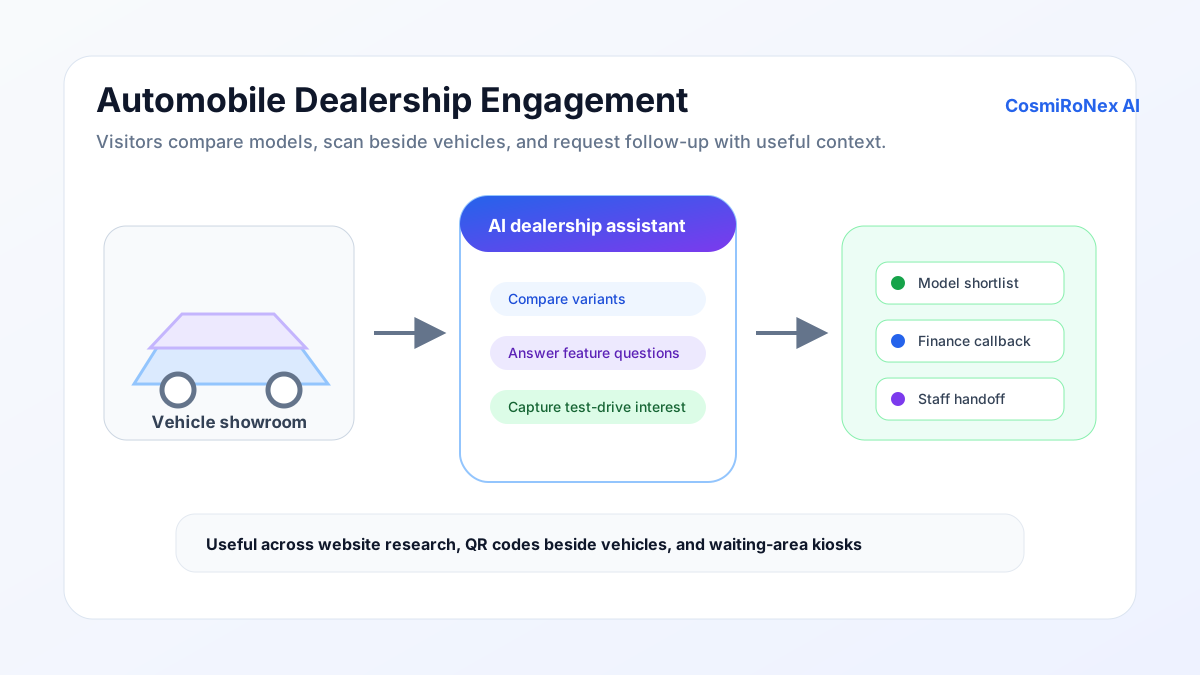
How AI supports automobile dealerships
Buying a car is one of the longest and most information-intensive purchasing decisions a household makes. The research process spans weeks or months, involves multiple touchpoints — online, telephone, showroom visit — and requires the customer to evaluate dozens of attributes across several competing models before settling on a shortlist to test drive.
Automobile dealerships face a customer engagement challenge at every stage of that journey. Customers who arrive at the dealership website need detailed information about models and variants. Customers who walk into the showroom beside a vehicle want specification answers without waiting for a busy salesperson. Customers in the waiting area while a vehicle is being prepared may have questions about ownership, financing or service policy.
An AI assistant grounded in the dealership's uploaded product documents and policies supports all three contexts — website, showroom floor and waiting area. It answers specification and feature questions, captures test-drive and finance interest, and facilitates a clean handoff to the appropriate staff member when the conversation reaches a point that requires human judgment or negotiation.
The automobile research journey
Most car purchases begin well before the showroom visit. A customer who has decided they need a new vehicle starts by identifying candidate models, comparing variants within those models, understanding the difference between fuel types, body styles and feature tiers, and narrowing to a shortlist. This research often happens across multiple sessions on multiple devices — a phone at lunch, a laptop in the evening, a tablet at the weekend.
Dealership websites are the primary research destination for this phase. A customer who arrives at a dealership website is already in an evaluation mindset — they want specific answers, not general marketing. The questions they ask are not "tell me about your brand" but "what is the difference between the base variant and the mid variant of this model?" or "does this SUV support wireless Android Auto in the standard trim?"
An AI assistant on the dealership website can address these questions directly from the uploaded product brochures and specification sheets. A customer who gets a clear, specific answer at 10pm on a Sunday is more likely to schedule a showroom visit than one who fills out an enquiry form and waits for a call on Monday.
Model and variant comparison
Within a single model, a modern car is available in multiple variants — differing in engine type, fuel (petrol, diesel, CNG, electric), transmission, feature tier and sometimes body size. Comparing these variants is one of the most common tasks a prospective buyer needs to accomplish before deciding which to test drive.
The AI assistant compares models and variants based on the information in the dealership's uploaded brochures and specification sheets. For a customer who asks "what is the difference between the petrol and diesel version of this model?", the assistant can address fuel efficiency, engine output, torque, transmission options and any variant- specific feature differences — as documented in the uploaded materials.
Comparisons across models — "how does this SUV compare to the similarly-priced competitor model?" — are limited to information about models the dealership has uploaded documents for. The assistant does not access competitor brochures or external comparison databases.
Feature and specification questions
Feature questions in automobile retail are often highly specific. A customer choosing between two SUVs might want to know which one has a panoramic sunroof in the mid trim, which supports wireless charging in the standard variant, or which has a longer rear seat legroom figure in the documentation.
These questions are well-suited to AI response from uploaded brochure data. The assistant can locate feature availability information across variants and report it in plain language, without requiring the customer to navigate multiple pages of specification tables or wait for a callback.
For features that affect safety — airbag count, ADAS system details, braking specifications — the assistant reports what the uploaded documentation states. It does not supplement this with external safety ratings, manufacturer claims from other sources, or its own assessment of safety adequacy.
Website research before visiting
The Website AI Widget is the primary surface for supporting the pre-visit research phase. A customer who arrives at the dealership's website with a specific model in mind can use the widget to ask variant comparison questions, understand feature availability, check documented dimensions for a parking space concern, or ask about colour and upholstery options — all from the uploaded product data.
The widget can also capture showroom visit interest during the research phase. A customer who has narrowed their shortlist and is ready to test drive can leave their name and preferred contact time via the widget, giving the dealership a qualified lead with relevant context: which model, which variant, what the customer's current situation is.
Website engagement before a physical visit reduces the time a showroom consultant needs to spend on basic specification education. A customer who has already compared variants online arrives at the dealership ready for a test drive, not a product walkthrough.
QR codes beside vehicles
In the showroom, QR codes placed beside display vehicles give customers a way to engage with detailed product information on their own phone while physically standing beside the car. This is particularly valuable during busy periods when every salesperson is occupied with another customer.
A customer beside an SUV can scan the QR code and ask: "does this variant have ventilated front seats?", "what is the boot space in litres?", "does the top trim come in this colour?" — and receive answers from the uploaded brochure data without waiting. They can also register their interest as a lead: "I want a test drive of this variant" or "I'd like someone to call me about pricing."
The QR code placement strategy matters. Placing codes on every display model, beside the colour swatches, and near the variant comparison posters gives customers multiple entry points to the AI assistant at the moments when they have specific questions.
English and Hindi text conversations are available through the QR Assistant, allowing customers to ask questions in either language while standing beside a vehicle. Other Indian languages are not currently supported.
Waiting-area kiosk
An AI kiosk in the dealership waiting area serves a different customer segment from the showroom-floor QR codes. Customers in a waiting area — waiting for a service appointment to complete, waiting for a test drive slot, waiting for paperwork — have time and are often considering their next vehicle or thinking about service-related questions.
A kiosk in this context can engage customers with the dealership's current vehicle range, answer questions about service plans and maintenance schedules, provide policy information about extended warranty or roadside assistance, and capture interest in upcoming model launches or exchange programme enquiries.
The waiting-area kiosk is also an appropriate surface for customers who are accompanying a primary buyer — a spouse or parent who has an independent set of questions about safety features, fuel economy or bootspace — while the primary buyer is engaged with a consultant.
Test-drive interest capture
Test-drive interest is one of the highest-value leads a dealership can capture. A customer who registers interest in a specific model test drive has moved from research to active evaluation — they are closer to a purchase decision than any browsing signal.
The AI assistant captures test-drive interest through the lead form capability. A customer who says "I want to test drive this SUV" via the website widget, QR code or kiosk is registered as an interested lead with the relevant model and variant context. The dealership's staff receive this lead for follow-up to schedule the actual drive.
Finance callback interest
Finance and EMI questions are among the most common at automobile dealerships, and they are also among the most variable — the relevant figures depend on the customer's credit profile, down payment, loan tenure and current lender rates, none of which the AI assistant has access to.
The appropriate response to finance questions is to capture the customer's interest and arrange a callback from the dealership's finance team. The assistant registers the enquiry — which model, which variant, the customer's stated situation — and passes it to staff as a qualified lead. The finance team contacts the customer with accurate, current information.
This is preferable to the assistant attempting to provide indicative EMI figures that may be inaccurate for the customer's specific credit and lending situation. A callback from a finance specialist with correct numbers is more valuable than an AI-generated estimate that could mislead the customer about affordability.
Ownership and policy questions
Customers at various stages of the purchase journey ask about ownership-related topics: service intervals, the cost of standard maintenance, roadside assistance coverage, what happens if the vehicle needs a repair during the warranty period, whether the warranty covers a particular component category.
The assistant answers these questions from the uploaded policy and ownership documents. Service plans, warranty terms and roadside assistance coverage that the dealership has documented can be explained clearly. Questions that require accessing a specific customer's service history, a live quote for a repair, or a confirmation that a specific claim will be approved require a staff member with access to the relevant systems.
Post-purchase customers who engage with the dealership's website or QR codes can also use the AI assistant for routine ownership questions — without occupying service desk staff time for information that is already documented and available.
Staff handoff
Every meaningful automobile purchase conversation eventually reaches a point where a human consultant adds more value than an AI assistant. The goal of the AI assistant is not to replace this conversation but to ensure it starts with better context.
A customer who has used the website widget to compare two variants, narrowed to one, and registered test-drive interest arrives at the dealership with a specific request rather than a general enquiry. A consultant who receives a lead note that says "customer is comparing the mid and top trim of this SUV and wants a test drive of the diesel mid variant" can prepare accordingly.
For in-showroom interactions via QR code or kiosk, the assistant can initiate a direct staff connection — flagging to available staff that a specific customer beside a specific vehicle has registered interest — reducing the time a customer waits for attention after they have already decided they are ready to talk.
Limitations
- No live pricing or offers. The assistant answers from uploaded documents. Exchange rates, festival offers, dealer-specific discounts and current financing incentives require confirmation from the dealership's sales or finance team.
- No live stock or delivery confirmation. Whether a specific variant and colour combination is available for immediate delivery requires a real-time inventory check that is outside the scope of uploaded documents.
- No finance rate or EMI commitment. Finance terms depend on the customer's credit profile and lender conditions, which the assistant cannot access. Finance queries are captured as callbacks, not answered directly.
- No confirmed test-drive booking. Test-drive interest is registered and passed to staff for follow-up. The assistant does not confirm a date, time or slot.
- No mileage, safety or independent review data. The assistant reports documented specifications from uploaded brochures. Independent fuel-efficiency testing results, NCAP safety ratings and editorial reviews are outside the scope of the assistant's responses.
- Answers rely on approved dealership documents. The accuracy of all responses depends on the quality and currency of the product documents the dealership has uploaded. Outdated or incomplete brochures produce less useful responses.
- Two-wheelers are not covered. This configuration is for car and SUV dealerships. Two-wheeler dealerships have a separate customer journey and evaluation framework.
AI Kiosk product demonstration
Related articles
Ready to explore how CosmiRoNex AI works for your retail business?
Explore AI solutions for automobile dealerships