
How Furniture Showrooms Can Improve Customer Experience with AI
How furniture showrooms guide customers through dimensions, materials, finish and customisation enquiries — using AI product discovery and QR assistants.
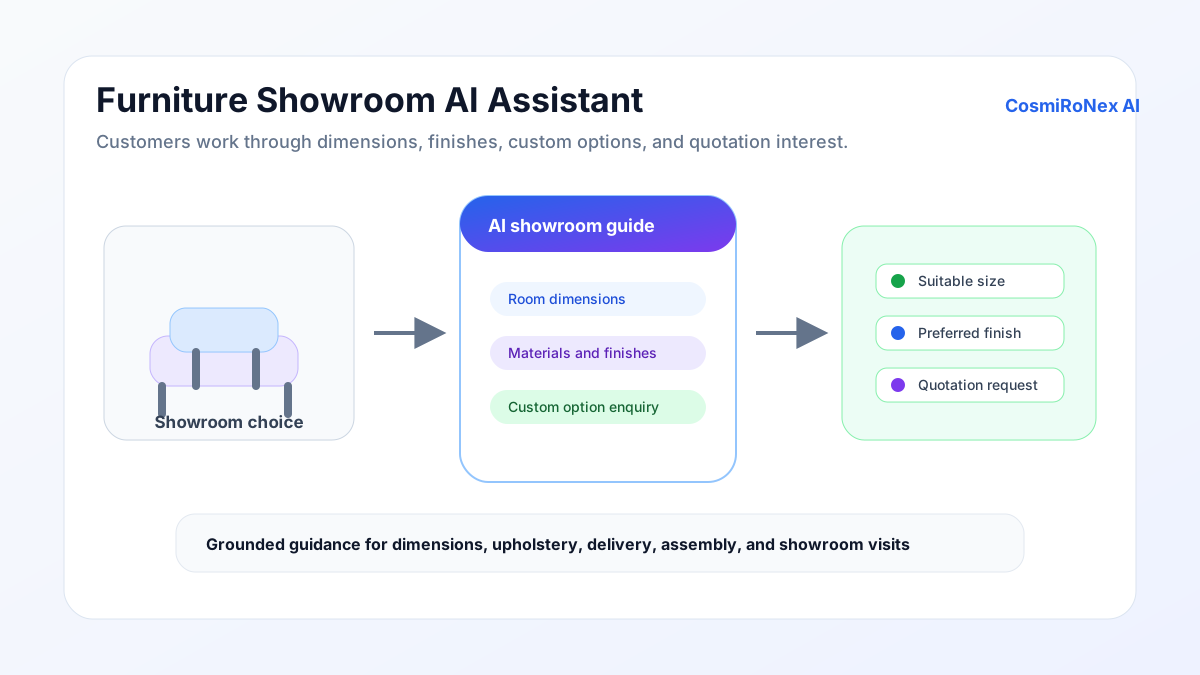
How AI supports furniture showrooms
Buying furniture is one of the highest-consideration purchases a household makes. The decision involves practical constraints — dimensions, structural requirements, number of seats — and preference-driven choices — style, material, colour, finish. It also involves a significant time investment: measuring the space, browsing options, revisiting the showroom, waiting for a staff member to become available, requesting a quotation.
An AI assistant grounded in a furniture retailer's uploaded product catalogue can reduce the time and friction at each of these stages. It accepts dimension inputs from the customer, matches them against documented product measurements, answers material and finish questions, captures customisation interest, and provides delivery and assembly policy information — all without requiring a staff member to be present for every conversation.
This does not replace the role of a skilled furniture consultant for complex decisions or room-planning advice. It handles the high volume of standard questions that occur before a customer reaches the point of needing that specialist conversation.
Why furniture decisions take time
Unlike many retail categories, furniture purchases are constrained by the physical environment into which the product must fit. A sofa that is attractive in a showroom may be impractical if it cannot navigate the customer's entrance corridor, if it occupies too much of a living room, or if its leg style marks a wooden floor that the customer wants to protect.
These constraints mean customers frequently leave a showroom without purchasing — not because they are uninterested, but because they need to go home and measure, or consult a family member, or confirm a detail they should have checked before visiting. Each of these friction points is an opportunity for a purchase to not happen: the customer's attention moves on, the visit is not repeated, or a competitor is visited in the intervening days.
The same pattern applies to online browsing. A customer who finds an attractive sofa but is uncertain whether the dimensions fit their space, whether the upholstery is available in the fabric they prefer, or whether the delivery timeline suits their move-in date will not add the item to their cart. They will save a screenshot and come back later — or they will not.
An AI assistant that can receive dimension inputs, answer material questions and capture interest immediately reduces the number of these drop-off moments.
Customer-provided room dimensions
When a customer provides the dimensions of their available space — "I have a wall space of 2.4 metres wide and 0.5 metres deep for a sideboard" — the AI assistant uses those dimensions to filter the retailer's uploaded product catalogue and identify which options are dimensionally appropriate.
This is the single most practically useful capability for furniture retail. Dimension matching prevents customers from becoming interested in products that cannot physically fit their space, and it reduces the number of situations where a customer orders furniture that must subsequently be returned because of a size mismatch.
The assistant accepts dimensions in natural language: "my doorway is 85 cm wide" or "I need something that fits in a 3 by 4 metre room with a sofa already taking up one wall." It matches these against the length, width, depth and height information documented in the retailer's product sheets.
Matching dimensions with product data
The quality of dimension matching depends on the completeness of the retailer's uploaded product specifications. A sofa listing that includes external dimensions — overall width, depth and height — but omits armrest-to-armrest width or seat depth gives the assistant less to work with than a comprehensive specification sheet.
Retailers benefit from ensuring that their uploaded product data includes consistent dimension fields across the catalogue. Products with missing dimension data cannot be evaluated by the assistant for dimension suitability and may be overlooked in responses even when they would be appropriate.
Where dimension data is available, the assistant presents matched options with the relevant measurements clearly stated, so the customer can verify the fit against their own space before engaging further.
Materials, finishes and upholstery
Material and finish questions are among the most frequent in furniture retail. Customers ask about fabric durability, whether a finish is scratch-resistant, whether a specific wood tone is available, whether a fabric is suitable for homes with pets or children. These are suitability questions, not purely specification questions — they require mapping a documented material attribute to a customer's specific situation.
The assistant answers material questions from the retailer's uploaded product documentation. If a product's upholstery is described as a specific fabric type with documented characteristics — stain resistance, thread count, cleaning method — the assistant can provide that information and apply it to the customer's stated context.
Finish questions — colour, texture, gloss level, wood grain — are answered from uploaded product images and descriptions. If the retailer's documents specify that a product is available in three finishes with names and visual descriptions, the assistant can guide a customer toward the most relevant option based on their stated preference.
Where a customer is asking about a specific fabric's long-term durability or maintenance requirements that are not documented in the uploaded product data, the assistant acknowledges the gap and recommends confirming with a staff member or referring to the product's care guide.
Style and suitability questions
Style questions in furniture retail operate differently from specification questions. "Does this sofa suit a Scandinavian interior?" or "would this dining table work in a small apartment?" are not questions with a single correct answer — they depend on the customer's broader interior context, which the assistant cannot see.
The assistant can provide useful input on style questions by drawing on the product descriptions the retailer has uploaded. If a product is described as "mid-century modern" or "suitable for compact spaces" in the catalogue, the assistant can reflect that framing. It cannot offer the kind of visual and contextual judgment that an experienced interior design consultant provides.
For customers who are uncertain about style fit, the assistant can suggest a showroom visit — capturing their interest and scheduling context as a qualified lead — rather than attempting to make aesthetic judgments beyond what the documentation supports.
Customisation enquiry capture
Many furniture retailers offer customisation options: fabric choice, finish selection, dimension modification, leg style substitution. Customers who are interested in a customised configuration often have difficulty finding out what is available and what it would cost without engaging directly with a specialist.
The AI assistant can capture customisation interest and relevant context — which product, which dimensions, which fabric preference, which delivery timeline — and register it as a qualified lead for follow-up by the appropriate staff member. The assistant does not generate a customisation quotation, and it does not confirm that a specific customisation is possible — those require retailer confirmation.
Delivery and assembly-policy questions
Delivery is a significant logistical consideration for furniture purchases. Customers ask about estimated timelines, delivery area coverage, whether white-glove delivery is available, whether assembly is included, and how large items are transported into upper-floor apartments.
The assistant answers delivery and assembly questions from the retailer's uploaded policy documents. Standard delivery terms — timelines, service areas, assembly inclusion — can be documented and made available through the assistant. Questions about specific delivery dates, real-time availability of assembly slots, or exceptional delivery requirements — staircases, restricted access — require a staff member with access to live scheduling information.
Customers asking about delivery who cannot get a precise answer from the assistant can be directed to capture their interest as a lead with a preferred contact time, enabling a staff member to follow up with the specific information they need.
Quotation and showroom-visit interest
High-value furniture purchases often require a formal quotation — particularly for room-scale purchases, fitted furniture, or commercial orders. The AI assistant captures quotation interest as a lead, recording the customer's product interest, configuration requirements and preferred contact method. It does not generate a quotation itself.
Showroom-visit interest — a customer who has browsed online and wants to see a product in person before committing — is similarly captured as a lead. The assistant can provide relevant showroom information (if documented), note the customer's interest in a specific product, and pass this context to a staff member for follow-up.
These lead-capture moments are among the most commercially valuable interactions the assistant enables. A customer who would otherwise have closed a browser tab or left the showroom without leaving contact details becomes a traceable, qualifiable enquiry.
Website Widget and QR roles
In furniture retail, the two most relevant AI surfaces are the Website AI Widget and the QR Assistant.
The Website AI Widget serves customers during the online research phase — often the longest phase of a furniture purchase decision. A customer who arrives on the retailer's website, browses sofas, and then has a dimension or material question can engage with the widget immediately rather than searching for a contact form or waiting for store opening hours. The widget captures dimension queries, answers material questions, and registers quotation or showroom-visit interest.
The QR Assistant serves customers who are physically in the showroom. Placed on a product tag beside a display item, it allows a customer to scan and ask dimension questions, request fabric swatches information, or register customisation interest via their own phone — without requiring a staff member to be present at that exact moment.
Limitations
- No automatic room measurement. The assistant accepts customer-provided dimensions. It cannot measure a room, estimate clearances from a photo, or access architectural drawings.
- No AR or room-visualisation. The assistant does not display furniture in a customer's room via augmented reality or virtual room-planning tools. It provides dimension matching and product descriptions.
- No automatic quotation. The assistant captures quotation interest and collects relevant context. Generating an actual quotation requires retailer involvement.
- No confirmed delivery timeline. Standard policy timelines from uploaded documents can be shared. Specific delivery date availability requires a staff member with access to live scheduling.
- No price commitment. The assistant can report prices from uploaded product data. Promotional pricing, customisation surcharges and negotiated rates require retailer confirmation.
- Customisation requires retailer confirmation. Available options from uploaded documents can be described. Whether a specific configuration is feasible at a given price and timeline requires the retailer to confirm.
- Style judgment is limited to documented descriptions. The assistant reflects the style language used in the retailer's product descriptions. It cannot make the kind of contextual aesthetic judgment that a human interior design consultant can provide.
QR Assistant product demonstration
Related articles
Ready to explore how CosmiRoNex AI works for your retail business?
Explore AI solutions for furniture showrooms